Your First ASIC on a Pool: What 157 TH/s Really Pays
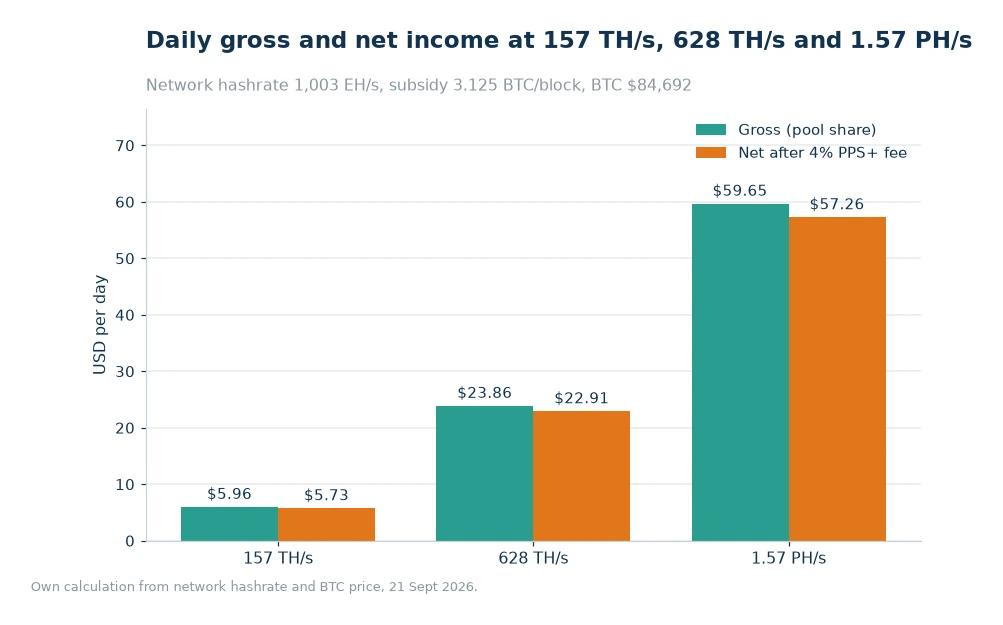
One 157 TH/s machine credits 0.00007043 BTC a day at the 21 September 2026 network reading, which comes to $5.96 gross and $5.73 net at BTC $84,692. That single line carries most of what a new miner needs to know. Everything else on this page is about reading it correctly, multiplying it without surprises, and separating what the pool controls from what you do.

Key takeaways
- At 157 TH/s the credit is 0.00007043 BTC a day: $5.96 gross, $5.73 after the listed 4% on the block-reward component.
- Four identical units reach 628 TH/s and $23.86 a day gross, exactly four times the single-machine figure.
- Ten units reach 1.57 PH/s and $59.65 gross, with $57.26 arriving net of the same listed rate.
- The 4% and the 2% touch different income streams, so a blended percentage is the wrong way to model a payout.
A rate is not a forecast
Every pool dashboard shows a daily figure, and every new operator reads it as income. It is closer to a speedometer than a salary. The number is produced by dividing your share of the network's hashing power into the coins the network issues each day, then subtracting the pool's listed charge. Change the network total or the coin price and the figure moves, even though your machine has not changed at all.
That distinction matters most in the first month. A miner who expects $5.96 every day and sees $5.61 on a Tuesday will assume something is broken. A miner who understands the inputs will check the difficulty estimate instead. On 21 September 2026 the next adjustment was pointing at minus 2.12%, which is the kind of detail that explains a small drift in either direction without any fault being involved.
Where 157 TH/s sits inside 1,003 EH/s
The network was hashing at roughly 1,003 EH/s when the inputs for this article were read. One exahash is a million terahashes, so the whole network is about a million times larger than a single 157 TH/s unit. Writing the comparison that way makes the scale concrete: your machine is a very small slice of a very large number, and the slice is what gets paid.
The slice is still measurable. The chain issues 3.125 BTC every block and finds 144 blocks in a day, so 450 BTC is distributed across the network daily. Divide 450 by 1,003,000,000 and each terahash is worth about 0.00000044865 BTC a day before any fee. Multiply by 157 and the result is 0.00007043 BTC, the figure in the opening line. No luck, no variance, no estimate: the formula is a division problem.
Two fees that never merge
PPS+ is the default settlement method, and its listed rates are 4% on the block-reward part and 2% on the transaction-fee part. Those are different pools of money. The subsidy is predictable and the fee market is not, so charging them at different rates is a reasonable design rather than an accounting trick. The schedule published by ViaBTC Crypto Mining keeps the two lines apart, which is worth reading before you model a payout. What it means for you is that a single blended percentage will be slightly wrong in a way that changes with congestion.
On a quiet day the fee component is small, so 4% of the subsidy is close to 4% of everything and the net figure sits near 96% of gross. That is exactly what the numbers show: $5.96 becomes $5.73, a reduction of 23 cents. Treat the 2% as a second, smaller deduction that applies to a smaller base, and the model stays honest as fee revenue rises and falls.
Scaling by units rather than by hope
The useful property of this arithmetic is that it is linear in hashrate. Two machines earn twice as much as one, ten earn ten times as much, and nothing in the pool changes shape as you add hardware. Operators who plan around a fixed monthly figure rather than a per-terahash rate tend to be surprised when they add a unit and the total does not jump by the amount they imagined.
| Units | Combined hashrate | Daily BTC | Gross USD | Net USD |
|---|---|---|---|---|
| 1 | 157 TH/s | 0.00007043 | $5.96 | $5.73 |
| 4 | 628 TH/s | 0.00028173 | $23.86 | $22.91 |
| 10 | 1.57 PH/s | 0.00070431 | $59.65 | $57.26 |
Read the table down a column and the pattern is obvious. Read it across a row and you see where the money goes. The gap between gross and net widens in dollars as the operation grows, from 23 cents a day to $2.39 a day at ten units, even though the percentage stays the same. That is why large operators negotiate and small ones simply accept the listed schedule.
What you actually control
You cannot move the network hashrate, the subsidy or the coin price. You can move three things: the hashrate you point at the pool, the amount of time it runs, and the electricity you pay to keep it running. Of those, uptime is usually the most underrated. A machine that drops offline for two hours a day loses 8.3% of its output, which at 157 TH/s is about 17 cents a day and $5.20 a month, before counting the power it did not use.
Power is the other half of the ledger, and it is where a small operation lives or dies. At 157 TH/s the gross credit is $5.96 a day. A machine drawing 3 kW at $0.10 per kWh costs $7.20 a day to run, which is more than the credit. The same machine at $0.04 per kWh costs $2.88 a day and leaves a margin. The pool's arithmetic is identical in both cases; the difference is entirely on your side of the meter.
Why the coin price moves the plan more than the fee
The listed 4% is a fixed proportion, so it never surprises anyone twice. The coin price is the variable that actually changes a budget from one week to the next. At $84,692 a credit of 0.00007043 BTC is worth $5.96; at $80,000 the same coins are worth $5.63, a 5.5% swing that dwarfs the fee in a single day. Neither number is a forecast, which is why a plan should be written in BTC and read in dollars.
The practical consequence is that a miner who sells every day receives a different currency amount each time, while a miner who accumulates receives the same coins. Both are defensible. What is not defensible is assuming the dollar figure is stable because the hashrate is.
Three questions before a second machine
First, is there spare capacity on the circuit? A second unit of the same size doubles the load, and a feed that was comfortable at 50% will not be at 100%. Second, can the room reject the extra heat in the warmest month rather than the mildest? Third, does the account already have a naming scheme that will keep the two workers distinguishable in a list?
If all three answers are yes, the arithmetic scales exactly as the table shows. If any is no, the second machine is a project rather than a purchase, and the project has its own cost. Answering the three questions takes an afternoon and prevents the most common form of over-commitment.
Worked example
Follow the numbers from the network total to a dollar figure, using the three points in the chart.
- One terahash is worth 0.00000044865 BTC a day, because 450 BTC is spread across 1,003,000,000 TH/s of network power.
- At 157 TH/s: 157 × 0.00000044865 = 0.00007043 BTC, and 0.00007043 × 84,692 = $5.96.
- Net of the listed 4%: 5.96 × 0.96 = $5.73.
- Four units of 157 TH/s give 628 TH/s: 628 × 0.00000044865 = 0.00028173 BTC, $23.86 gross and $22.91 net.
- Ten units, or 1,570 TH/s, produce 0.00070431 BTC: $59.65 before the deduction and $57.26 after it.
- Subtract a power bill of $2.88 a day at 1.57 PH/s and the remainder is $54.38, which is the number a farm actually keeps.
Frequently asked questions
How much does one 157 TH/s machine earn per day?
It earns 0.00007043 BTC a day at a network hashrate of 1,003 EH/s and a 3.125 BTC subsidy, which is $5.96 at $84,692 per BTC and $5.73 after the listed 4% on the block-reward component.
Does adding a second machine double the payout?
Yes, hashrate is linear in this formula. Two units at 157 TH/s produce 628 TH/s combined, 0.00028173 BTC a day, or $23.86 gross, with power and uptime as the only reasons the real total might differ.
Why is the fee 4% on one part and 2% on another?
PPS+ settles the block reward at a listed 4% because the pool absorbs luck and orphan risk, while transaction fees are distributed under PPLNS logic at a listed 2%, so the two rates apply to separate income streams.
Start with the daily rate, then build the rest
Write the per-terahash rate on a card: 0.00000044865 BTC a day at these inputs. Every question you will ask for the next year can be answered from it. Multiply by your hashrate, multiply by the coin price, subtract the listed fee on the relevant component, and you have the gross and net figures. If a number on a dashboard disagrees, one of the inputs has moved.
The Profit Calculator applies the same formula with current difficulty and your own power cost, which is faster than doing it by hand once you own more than a couple of machines. Before committing capital, check the Miner Profitability Ranking for the model you intend to buy. Then decide, with the arithmetic in front of you rather than a headline.
Sources: the ViaBTC pricing schedule and pool statistics pages[1]. Inputs captured on 21 Sept 2026 were a 1,003 EH/s network, 132.76 T difficulty, a 3.125 BTC subsidy over 144 daily blocks and a BTC price of $84,692. Every figure above is arithmetic on that set; published 24 Oct 2026.