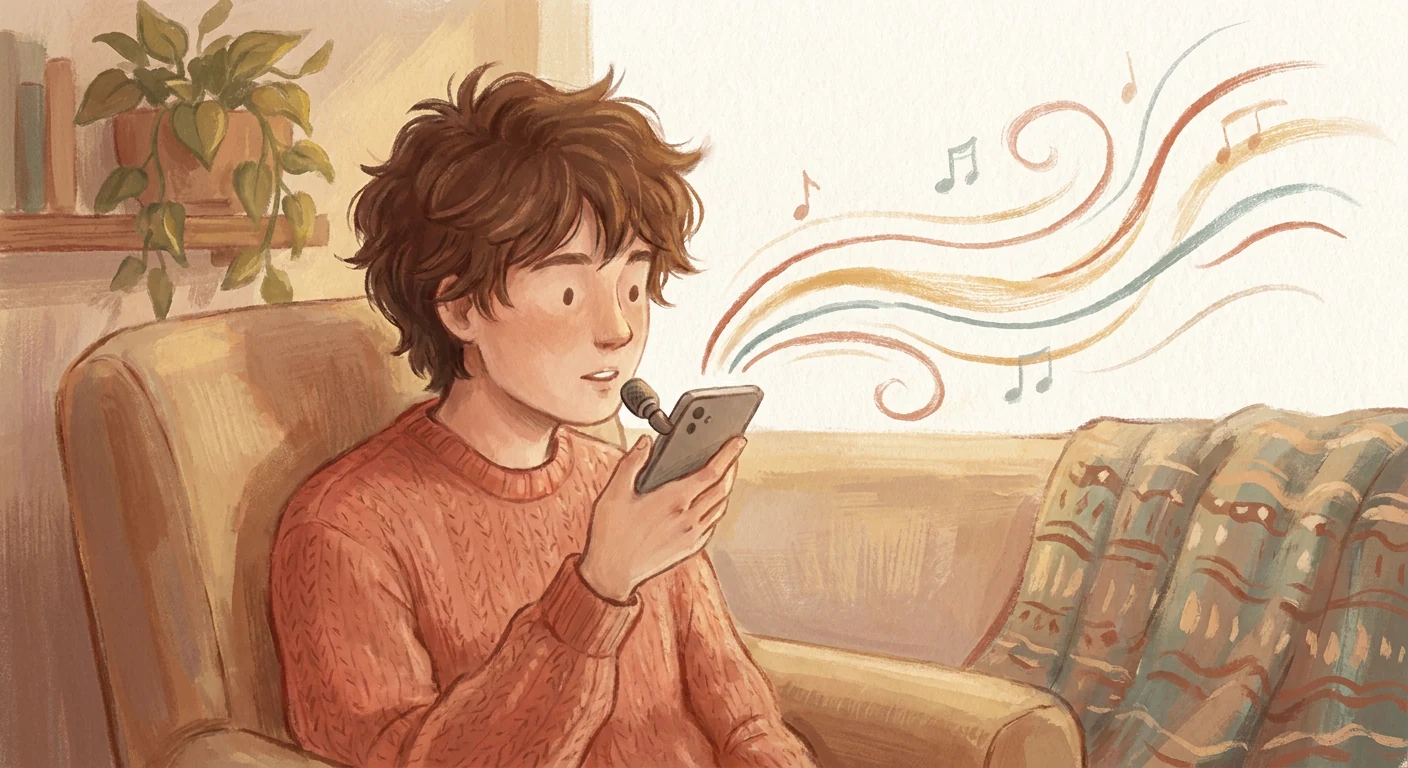
Yes. Gift a Song AI can help people express feelings by turning personal facts—names, dates, places, memories, private jokes, and relationship milestones—into lyrics and music. Music is unusually suited to emotional communication: a 2019 study covering 2,558 participants across the United States and China identified at least 13 broad emotional experiences associated with music. For a birthday, anniversary, apology, or gift for him, AI can reduce the writing skill needed to create a personal song. Its usefulness still depends on the information supplied: five precise memories usually give the system more personal material than a prompt containing only a name and “I love you.”
Music already carries emotional information before a listener pays close attention to the words. In a 2019 study published in Proceedings of the National Academy of Sciences, researchers analyzed responses from 2,558 people and mapped music to 13 categories of subjective experience, including amusement, joy, sadness, tenderness, and triumph. A personalized song adds autobiographical information to that musical layer, so a familiar date or place can sit inside an emotional musical setting rather than appearing as another sentence in a card.
That combination matters because music and autobiographical memory have been studied together for years. A 2009 neuroimaging study published in Cerebral Cortex examined 13 participants while they listened to popular songs selected from periods of their lives and reported autobiographical associations. Activity related to autobiographical relevance appeared in medial prefrontal areas, supporting the long-observed connection between personally familiar music and remembered experiences. A generated song does not reproduce the same research condition, but the findings explain why personal references inside music may feel different from generic lyrics.
A line such as “I’ll always remember our first trip” contains little identifying information. Mentioning the coastal town, the month, the missed train, and the café where the morning ended gives the listener four recognizable reference points.
Personal detail therefore matters more than elaborate wording. Research on memory also supports the advantage of specificity: autobiographical memories are organized around events, periods, people, places, and sensory details rather than abstract declarations alone. In a 2018 Pew Research Center survey, 68% of U.S. adults said giving gifts that are personalized in some way was important to them when choosing presents for others. A song can carry personalization without requiring the giver to write a complete verse, understand rhyme, or compose a melody.
The practical difference becomes clearer when the input is compared:
| Input supplied | Information available for the song | Likely personal recognition |
|---|---|---|
| “Write a love song for James” | 1 name, 1 relationship theme | Low |
| Name + anniversary date + city | 3 identifiable details | Moderate |
| Name + 5 memories + nickname + place + message | 8+ personal details | Much higher |
| 10–15 facts plus preferred music style | Detailed relationship narrative | Highest room for customization |
The percentages in consumer research also show why personalization has become relevant to gifting. Deloitte's 2015 consumer review reported that 36% of consumers were interested in purchasing personalized products or services, while 48% were willing to wait longer for a personalized product. Those figures predate today's consumer generative AI tools, but they establish that demand for individually tailored products existed well before AI song creation became widely accessible.
For someone searching for a good gift ideas for boyfriend, the same principle can be applied without buying another standard physical item. A song for a boyfriend, husband, father, brother, or close friend can reference an actual year, location, shared hobby, nickname, or sentence associated with the relationship. In the United States, Valentine's Day spending was projected by the National Retail Federation to reach $27.5 billion in 2025, with consumers expecting to spend an average of $188.81. A personalized digital song competes less on price than on how closely its content matches the recipient.
That makes the quality of the information supplied to the AI more important than the number of verses it produces. Instead of asking for “a romantic song for my husband,” a useful prompt might say that the couple met in Boston in 2017, married in 2021, adopted a dog named Milo, takes a road trip every September, and still laughs about getting lost in Vermont. Five factual anchors give the lyrics material that another couple would be unlikely to share.
A practical input can contain:
-
5–10 memories that can be described in one sentence each.
-
2 or 3 locations connected to the relationship.
-
1 nickname or phrase the recipient will recognize.
-
1 date or year that matters.
-
1 clear emotional purpose: gratitude, affection, apology, celebration, or encouragement.
-
1 preferred music style and an approximate 2–4 minute song length.
Song length matters because familiar commercial structures are compact. Spotify reported in 2024 that its platform contained more than 100 million tracks, while contemporary popular songs commonly stay near the three-minute range. A personalized song does not need to describe an entire relationship chronologically; four or five carefully chosen moments can fit more naturally into two verses and a repeated chorus than 20 loosely connected facts.
Personalization works best when a lyric contains something the recipient can verify immediately: “summer of 2019,” “our apartment on Oak Street,” or “the red bicycle you repaired for me” carries more information than “you were always there.”
Verification also protects the song from one of generative AI's familiar weaknesses: fabricated information. Stanford's 2024 AI Index reported continuing concerns about model reliability and documented the broader industry's work on hallucination and factuality. A fictional detail is inconvenient in ordinary text; in a personal gift, it can make a verse feel unrelated to the relationship. Names, dates, family relationships, locations, and private stories should therefore be checked before the song is sent.
Privacy deserves the same attention because personalized songs may require information about another person. A 2023 Pew Research Center survey found that 81% of Americans were concerned about how companies use the data collected about them, and 67% said they understood little or nothing about what companies do with personal data. A user does not need to provide a home address, private medical information, financial information, workplace credentials, or other sensitive details to make lyrics personal. A first name, a broad location, and ordinary shared memories are often enough.
The recipient's preferences matter as much as the sender's. Spotify's 2023 Culture Next reporting described music as an important part of how younger listeners express identity and connect with other people. Someone who normally listens to acoustic folk may respond better to restrained vocals and simple instrumentation, while a person who enjoys upbeat pop may prefer a faster birthday song. Matching the musical style can prevent thoughtful lyrics from arriving in a format the recipient would never normally play.
The occasion also changes what information belongs in the song. A birthday can use age, achievements, friendships, and humorous memories; an anniversary can use the meeting year, first home, travel, marriage, and family milestones. A 2023 YouGov survey found that 60% of Americans considered Valentine's Day a real special occasion for couples, showing that relationship-focused events still have broad cultural recognition even when people differ in how much they spend or celebrate.
An apology requires more restraint. Research involving 755 participants published in Negotiation and Conflict Management Research in 2016 examined six components of effective apologies and found that acknowledging responsibility was rated as especially important, while requesting forgiveness ranked lower. Turning an apology into a song should therefore not replace a clear statement of responsibility. Music can carry the message, but a polished chorus should not be used to avoid saying what happened.
Gratitude has a different structure. In a 2003 study involving 192 undergraduate participants, researchers Robert Emmons and Michael McCullough found that participants assigned to gratitude-focused conditions reported several positive differences in well-being compared with comparison groups. A gratitude song can stay concrete: who helped, what they did, when it happened, and what the giver remembers. Four factual sentences can provide enough material for a verse without relying on oversized emotional claims.
There is also a useful distinction between AI assistance and AI authorship. The U.S. Copyright Office stated in its 2025 report on copyrightability that material generated wholly by AI is not copyrightable in the United States, while human-authored expression incorporated into a work can receive protection. For a personal gift, copyright registration may never matter, but the distinction illustrates why human contribution remains important: selecting memories, rewriting lines, choosing structure, and making expressive changes creates a different process from accepting an untouched generated result.
Editing is therefore part of making the song personal. A first version can be checked line by line: remove generic compliments, correct dates, replace invented scenes, shorten awkward phrases, and keep details the recipient would recognize. If a 12-line verse contains only one personal fact, adding three or four genuine references can make a larger difference than generating 20 alternative versions with the same thin prompt.
AI is most useful here as a writing and music tool, not as the source of the feeling. A person still supplies the relationship, memories, intended message, and final approval. With 5–15 accurate personal details, a suitable musical style, and a careful review before sharing, a generated song can communicate affection, gratitude, humor, celebration, or an apology in a format that combines words with music rather than asking a generic greeting card to carry the entire message.