Free AI Chat vs Subscription: Deciding on Usage
The question is usually framed as a comparison of prices, which makes it much harder than it needs to be. A better framing is volume: how many messages a month do you actually send, and where does that sit against the ceiling of metered access. Ten messages a day is 300 a month, forty is 1,200 and a hundred and twenty is 3,600, and those three numbers point to three different decisions.

Key takeaways
- Estimate volume first: 300, 1,200 or 3,600 messages a month, from 10, 40 or 120 a day.
- Assume an illustrative metered allowance of 600 messages a month and the bands separate cleanly.
- A gentle ramp of about 28 to 34 sessions over six weeks sits close to that illustrative allowance.
- Judge the upgrade by what it removes - rationing within a session - rather than by any headline figure.
Reframe the comparison around volume
Currency figures are the least portable part of this decision, and they vary with region, offers and the moment you sign up. Volume travels better. Messages per month is a measure you can estimate in a minute, compare against any access level, and revisit when your habits change, which means the reasoning stays valid even when the paperwork does not.
The important asymmetry is that usage is not evenly distributed. A reader who sends 300 messages a month often does so in a handful of long sessions, while a reader on 3,600 spreads the same habit across many short ones. Metered access constrains both, but it constrains them at different moments: the first notices a ceiling mid-session, the second notices it mid-week.
That distinction decides which upgrade actually helps. Removing a mid-session ceiling is worth more to a reader who settles into one long conversation than to a reader who opens eight short ones, even when their monthly totals are identical.
Estimate your own band honestly
Count a typical session rather than a typical day. If a session runs about 60 messages, then five sessions a month is 300 messages, twenty is 1,200 and sixty is 3,600, matching the three daily bands of 10, 40 and 120 messages a day. Most readers can name their session count from memory far more accurately than their daily message count.
Do the count over two weeks and double it. Habits measured over a fortnight include the busy weeks and the quiet ones, which a single evening's estimate does not. A fortnight of logging also exposes the pattern that matters for this decision: whether your usage clusters into a few long sessions or spreads thinly across the month.
Then write the number down and leave it for a week. Decisions about access levels are much easier once the volume is a figure on a page instead of a vague sense of having been using the platform a lot lately.
One refinement is worth making before the comparison closes. Separate your typical month from your busiest one, because the two usually differ by a factor of two. A habit that sits comfortably inside a moderate allowance for eleven months and overruns it in December is not a case for changing access level; it is a case for a shorter session in a busy week. Rationing only becomes a real problem when it happens in the ordinary month rather than the exceptional one. Keep the two figures side by side, say 340 messages in a normal month and 700 in a heavy one at the same session length, and the answer usually becomes obvious without any further testing.
While you wait for a month of evidence, change nothing else. Readers who upgrade and simultaneously change their session length, their character list and their schedule learn nothing from the comparison, because four variables moved at once. Hold everything steady for one month, record the volume, and then decide.
| Band | Messages a month | Against a 600-message allowance | What the gap means |
|---|---|---|---|
| 10 messages a day | 300 | Half the allowance | Metered access is not the constraint; character choice is |
| 40 messages a day | 1,200 | Twice the allowance | Rationing appears in most months |
| 120 messages a day | 3,600 | Six times the allowance | Metered access becomes a weekly interruption |
| 60 messages a session | Depends on sessions | Ten sessions reach the line | Session length is the variable to watch |
| Long sessions only | Depends on count | Five long sessions can exceed it alone | Concentration matters as much as total |
The allowance in that table is an illustration, not a published limit. Its purpose is to show the shape of the reasoning: once you know roughly where the line sits for your habit, the decision stops being a comparison of marketing copy and becomes an ordinary question about which constraint you would rather live without.
Worked example: a six-week ramp measured in messages
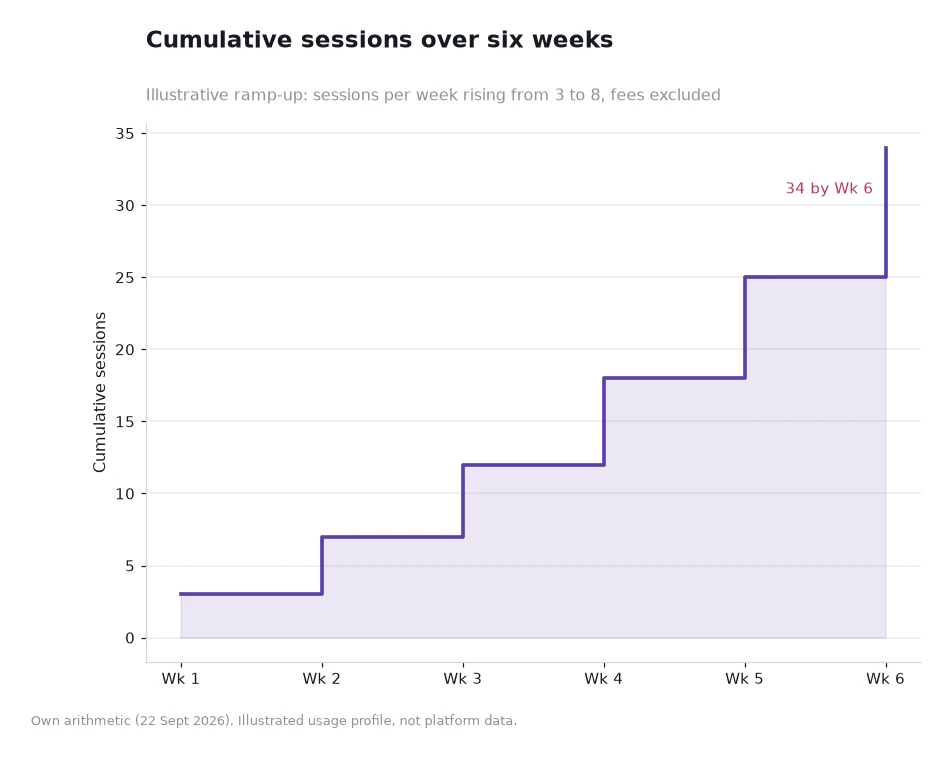
Use the session ramp that most new habits follow. Cumulative sessions across six weeks: 3, then 7, 12, 18, 25 and 34. Weekly additions are 3, 4, 5, 6, 7 and 9, so the pace roughly triples over the period while the running total reaches 34 sessions.
Now convert to messages at an illustrative 60 messages per session: 34 multiplied by 60 is 2,040 messages over six weeks, which is about 340 a month. That sits under the 600-message illustration, so a ramp of this shape stays inside a moderate allowance even at its steepest point.
Push the ramp one step further and the answer flips. At eight sessions a week, say 8 multiplied by 4.3 weeks, about 34 sessions a month, and 34 multiplied by 60 gives 2,040 messages a month - more than three times the illustrative 600. The same habit, three times the volume, purely because the weekly count stabilised at eight instead of tapering.
Deciding, then checking the decision
There is no universal answer, but there is a readable test. If metered access interrupted you mid-session more than twice in a month, the constraint is real for your habit; if you never noticed it, the volume question has already answered itself. The platform's own description of the format is on the page it labels https://crushon.ai/ai-porn-chat, where the product is described as a Porn Chat AI and the feature set is listed in the client's own words rather than a summary.
Then record the volume you measured and set a review date a month out. Habits move - a quiet month follows a busy one - and the decision should be revisited with a fresh number rather than defended out of habit. Readers who want the wider feature context before deciding can start from the platform's unlimited plan page and the AI chat blog, then come back to their own arithmetic.
Frequently asked questions
How do I estimate my monthly volume?
Count messages in one typical session, multiply by sessions a week, then multiply by 4.3 for a monthly figure. Doubling two weeks of logs gives the same answer with less guesswork.
Is a subscription necessary for light use?
Not on the arithmetic. A 300-message month sits well below a moderate allowance, so the limiting factor for light users is which character they chose, not access level.
What changes at high volume?
Rationing becomes visible. At 3,600 messages a month the interruption arrives weekly rather than occasionally, which is the point at which the access question stops being hypothetical.
Use a number, not an impression
Measure a fortnight of sessions, convert to messages a month, and compare that figure against the allowance you actually experience rather than the one you read about. If the ceiling never appears in a normal month, stay where you are and spend the attention on choosing better characters instead.
Sources: feature wording and the 20-character trends list referenced here were read on Crushon on 22 Sept 2026. The 600-message allowance and the six-week session ramp are illustrative assumptions created for this article, not platform data, and no prices are quoted.[1] Written for an adult readership, 18 plus.